Tuesday, May 12, 2015

2015 Literacy Leadership Awards : : National Coalition for Literacy

2015 Literacy Leadership Awards
The National Coalition for Literacy
May 14, 2015
5:30 PM to 7:30 PM
Washington, DC

The National Coalition for Literacy (NCL) Literacy Leadership Awards Event recognizes individuals and/or organizations that have made extraordinary national contributions to improving adult literacy and English language learning in the United States. Past awardees have included corporations, foundations, members of Congress, and adult literacy professionals. Light h'ors douerves and drinks will be served.

This year, the NCL will recognize the following outstanding individuals and organizations:

Representative Phil Roe (TN). Dr. Phil Roe is the U.S. Representative for Tennessee's 1st congressional district, serving since 2009. He has been a strong advocate for strengthening adult education and is the founding member and Republican co-chair of the House Adult Literacy Caucus.

Mayor Michael Nutter. In 2011, Mayor Nutter stated tackling the city’s adult literacy problem would be a priority for his administration. He made a $1 million investment in city adult literacy programs and reinstituted the Philadelphia Mayor’s Commission on Literacy, and tasked it with creating an online referral system that will allow real-time matching of adult learners to classes, tutors, testing and instruction, and to supplement face-to-face learning with opportunities for online learning and practice. That system, called myPLACE™, has served over 5000 adult learners to date.

Kavitha Cardoza. Ms. Cardoza is a Special Correspondent for WAMU and reports on D.C. area news, with a special focus on children, education and poverty. She has won numerous awards for her work including the regional Edward R. Murrow Award for Hard News in 2012. In 2013 she wrote and produced a four-part NPR series that highlighted the current adult literacy crisis facing communities across the country. This series provided some of the most in-depth coverage of this issue in the national media in recent memory.

Mary Jane Schmitt and Adult Numeracy Network (ANN). In 1994 Mary Jane Schmitt co-founded the Adult Numeracy Network which has been the leading voice advocating and providing PD for improved adult numeracy instruction. She also founded and directed the Adult Numeracy Center at TERC—a constellation of projects contributing to innovative research and development in adult mathematics education. Ms. Schmidt passed away earlier this year, and a representative from ANN will accept the award on her behalf.

The NCL Literacy Leadership Awards are made possible through the generous support of the Dollar General Literacy Foundation.

About the National Coalition for Literacy
The National Coalition for Literacy (NCL) is a coalition of the leading national and regional organizations dedicated to advancing adult education, family literacy, and English language acquisition in the U.S. NCL helps advocates, policymakers, and others who care about adult literacy make a positive difference advocating for adult education and family literacy.

Sunday, May 10, 2015

Literacy – Spanning the US: Prescott, AZ :: New Jersey :: Pittsfield MA


In addition to the United States, the adult learners came from places all over the globe such as Brazil, Bulgaria, Chile, China, El Salvador, Ghana, Korea, Indonesia, Pakistan, Tajikistan, Romania and many others.  READ MORE !

Wednesday, May 6, 2015

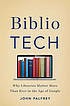
Future of the Stacks : : John Palfrey |:| Library as Third Place

Biblio
TECH
The Future of the Stacks
How closing libraries means losing more than just good memories
Medium: 5.05.2015 by John Palfrey

When asked what they like best about libraries, people often recall browsing in dimly lit stacks for a book. The browsing experience is one of the most magical childhood memories for many people. They have positive associations with the experience of tracking down a book by call number, wending their way through the aisles, and running their finger along the spines of books in musty library stacks.

The joy of unexpected discovery has enormous appeal to people of all ages and all walks of life. The library browsing experience is strongly associated with the concept of serendipity.

There is something powerful about the idea that patrons will find on the shelves books that they didn’t expect to find. To date, this experience has come about thanks to the physical proximity of other books to the book they are initially seeking. For some people, it is impossible to come out of the stacks without armfuls of books, even if they went into the stacks seeking just one. This serendipity has broader social implications too. New ideas and new connections between fields can be created as a result of these unexpected findings. This serendipity, this sense of discovery, relies on a long and complex chain of activities, many of them carried out by librarians.

There is reason to fear that this type of positive experience will be lost if library stacks, and the people who staff them, disappear. If libraries shed their physical collections and materials are rendered to patrons through electronic delivery only, the experience of serendipity could be lost forever. The same fear goes for the decline of the physical, printed newspaper.

When a reader searches only for a narrow topic and ends up with a single story, she may miss the surrounding stories that offer a broader snapshot of what’s happening in the world. (Even the prospect of moving previously inaccessible stacks can lead to public outcry, as occurred with the New York Public Library in 2012.)

If libraries were to disappear, cities and towns would lose essential “third places” that are open to the public. In a 2013 survey, 90 percent of Americans age sixteen and older said that the closing of their local public library would have a negative impact on their community. There are many sound reasons for this concern.

Outside of home and work, third places in many communities are shifting away from library spaces and toward commercial spaces, whether Starbucks in the physical world or Facebook in the virtual world.  READ MORE !


The Great
Good Place
The Library as Third Place
Library Journal: 2.17.2014 by Annoyed Librarian

Inspired by this article in the Chicago Tribune hailing libraries as “havens on earth,” I wanted to write about libraries as Third Places.

A Third Place is somewhere other than home or work, the first two places. From the Wikipedia article summing up Ray Oldenburg’s The Great Good Place, we find the following characteristic of third places:
Free or inexpensive
Food and drink, while not essential, are important
Highly accessible: proximate for many (walking distance)
Involve regulars – those who habitually congregate there
Welcoming and comfortable
Both new friends and old should be found there

Depending on the community, lots of public libraries could count as third places, especially those with cafes and open spaces outside the normally quiet stacks areas. People generally don’t sit around the reference section merrily conversing, but there’s often space for that sort of thing.

This is even perhaps what a lot of public librarians want libraries to become, even if they don’t put it in those terms. It might make a lot more sense of some of the activities now happening in libraries if the official goal was to make the public library into a Third Place.  READ MORE [comments] !

Sunday, May 3, 2015

Literacy – Spanning the US: Wicomico Co MD :: Columbia MO :: Tulare Co CA


Literacy: Key to solving many of society's ills
Delmarva Now: 4.10.2015 by Susan Parker

═════════►
READ MORE !

Board Chairman Steven Worthley read the proclamation, which stated that “The County of Tulare is pleased with the success of the library’s literacy programs for adults within Tulare County, and commends and publicly acknowledges the efforts of the program staff, volunteer tutors and learners in their future endeavors.”  READ MORE !

Thursday, April 30, 2015

Do We Need Libraries? : : Forbes

Do We Need Libraries?
Forbes: 4.28.2015 by Steve Denning

Libraries everywhere are under threat. After all, who needs a library today, when it is possible, without even getting out of bed, to find and read almost any book or article that has ever been published? One is tempted to recall the reaction by some to the recent news that Radio Shack had gone bankrupt: “Radio Shack bankrupt? I didn’t know Radio Shack still existed!”

I was asked to give the opening keynote at a combined meeting of the Library Leaders Summit and the Computers in Libraries conference this week in Washington, D.C. In discussing the future of libraries, the conference continues a long tradition of forward-looking libraries exploring emerging technologies, hearing from bleeding edge practitioners and sharing case studies of innovative libraries. My thoughts on the future of libraries are equally applicable to many other sectors that are facing the threat of extinction from massive disruption to their businesses.

The Scale of Disruption Today
The scale and pervasiveness of the disruption that sectors like libraries face is amazing.

The disruption begins with products. The smartphone, as Larry Downes and Paul Nunes explain in their book, Big Bang Disruption, is resulting in a huge array of products becoming obsolete:

Address books, video cameras, pagers, wristwatches, maps, books, travel games, flashlights, home telephones, dictation recorders, cash registers, Walkmen, Day-Timers, alarm clocks, answering machines, yellow pages, wallets, keys, phrase books, transistor radios, personal digital assistants, dashboard navigation systems, remote controls, airline ticket counters, newspapers and magazines, directory assistance, travel and insurance agents, restaurant guides and pocket calculators.

But the disruption isn’t limited to products. Whole sectors of commerce are under threat.

═════════►
Against this background, what is the future of libraries? There is no reason to think that libraries are necessarily immune from the Grim Reaper of disruption. Do libraries have a future at all?

═════════►
Five “Right” Approaches For Libraries
The future of libraries is a story that has yet to be written. I don’t pretend to have “the answer” to that story. The only thing we know for sure is that the story will be different from the story of libraries in the past. But here are five questions that could lead to the right answer. In fact, the key to unlocking the mystery requires asking the right questions.

═════════►
Using the right metrics to track customer delight will be important here. A informal poll at this week’s conference suggested that relatively few libraries are using the Net Promoter Score (NPS) methodology. Instead, the metrics in use seem to focus outputs, like numbers of users or circulation figures. Although we all love librarians because they are instinctively helpful, getting feedback from users about the overall utility of the library as a whole, using the NPS methodology, would give libraries a handle on whether their efforts to delight users are paying off—or not.  READ MORE !

Sunday, April 26, 2015

Literacy – Spanning the US: Santa Clara CA :: Asheville, NC :: Provo UT

3.25-31.2015


Members of the group welcomed her and together they read aloud a descriptive passage to identify adjectives and adverbs and their value in descriptive writing. Escobar took a deep breath and began reading an excerpt with words like specificity, mediocre, and generic.  READ MORE !

Friday, April 24, 2015

On World Book Day, UN hails reading and writing as pillars of sustainable societies

On World Book Day, UN hails reading and writing as pillars of sustainable societies
UN News Centre: 4.23.2015

As global symbols of social progress, books have always been targets for those who reject freedom and tolerance, the United Nations agency mandated with promoting education said today on World Book and Copyright Day, calling the occasion an opportunity to recognize the power of books to change lives for the better.

“In recent months, we have seen attacks on children at school and the public burning of books,” Irina Bokova, Director-General of UN Educational, Scientific and Cultural Organization (UNESCO), said today.

“In this context, our duty is clear – we must redouble efforts to promote the book, the pen, the computer, along with all forms of reading and writing, in order to fight illiteracy and poverty, to build sustainable societies, to strengthen the foundations of peace,” she added.

Literacy is the door to knowledge, essential to individual self-esteem and empowerment. Books, in all forms, play an essential role here.

World Book and Copyright Day – marked around the world on 23 April – was proclaimed by UNESCO in 1995 and is observed by millions of people in over 100 countries by schools, public organizations and private businesses.

With 175 million adolescents in the world – mostly girls and young women – unable to read a single sentence, UNESCO said it is committed to leading the fight against illiteracy, and for it to be included as a crucial ingredient of the sustainable development goals (SDGs).

“Literacy is the door to knowledge, essential to individual self-esteem and empowerment. Books, in all forms, play an essential role here,” Ms. Bokova stated.

═════════►
The Day – 23 April – is a symbolic date for world literature. It is on this date in 1616 that Cervantes, Shakespeare and Inca Garcilaso de la Vega all died. It is also the date of birth or death of other prominent authors, such as Maurice Druon, Vladimir Nabokov and Manuel Mejía Vallejo.  READ MORE !