Showing posts with label Pew. Show all posts

Saturday, August 24, 2019

Digital Literacy and Adult Learners via Digital Promise

Adult Learner Landscape
Digital Literacy and Adult Learners

An estimated 36 million adults in the U.S. lack the basic math, language, and digital literacy skills necessary to find well-paying jobs and navigate public and social systems. Technology can increase access to education, provides support and scaffolding, and offers personalized learning pathways for these learners to advance in their careers and life.


Digital Readiness Gaps, Pew 2016


Thursday, March 29, 2018

Who doesn’t read books in America? via Pew Research


Who doesn’t read books in America?
Pew Research: 3.23.2018 by Andrew Perrin

About a quarter of American adults (24%) say they haven’t read a book in whole or in part in the past year, whether in print, electronic or audio form. Who are these non-book readers? Several demographic traits correlate with non-book reading, Pew Research Center surveys have found. For instance, adults with a high school degree or less are about five times as likely as college graduates (37% vs. 7%) to report not reading books in any format in the past year. Adults with lower levels of educational attainment are also among the least likely to own smartphones, even as e-book reading on these devices has increased substantially since 2011. (College-educated adults are more likely to own these devices and use them to read e-books.)

Adults with annual household incomes of $30,000 or less are about three times as likely as the most affluent adults to be non-book readers (36% vs. 13%). Hispanic adults are about twice as likely as whites (38% vs. 20%) to report not having read a book in the past 12 months.  READ MORE >>

   General
America’s Most Literate Cities, CCSU
2016: Book Reading 2016, Pew
2013: Remodeling Literacy Learning, Natl Center for Literacy Education (NCLE)
2012: Improving Adult Literacy Instruction: Options Practice Research, NAS
2007: To Read Not To Read, NEA
2004: Reading At Risk, NEA

Tuesday, March 13, 2018

Nearly One-in-Five Americans Now Listen to Audiobooks :: Pew Research


Nearly one-in-five Americans now listen to audiobooks
Pew Research: 3.08.2018 by Andrew Perrin

Americans are spreading their book consumption across several formats, and the use of audiobooks is rising.

About three-quarters (74%) of Americans have read a book in the past 12 months in any format, a figure that has remained largely unchanged since 2012, according to a Pew Research Center survey conducted in January. Print books remain the most popular format for reading, with 67% of Americans having read a print book in the past year.

And while shares of print and e-book readers are similar to those from a survey conducted in 2016, there has been a modest but statistically significant increase in the share of Americans who read audiobooks, from 14% to 18%.

Overall, Americans read an average (mean) of 12 books per year, while the typical (median) American has read four books in the past 12 months. Each of these figures is largely unchanged since 2011, when the Center first began conducting the surveys of Americans’ book reading habits.  READ MORE >>

Thursday, June 22, 2017

Millennials are the most likely generation of Americans to use public libraries

Millennials are the most likely generation of Americans to use public libraries
Pew Research Center: 6.21.2017 by Abigail Geiger

Millennials in America are more likely to have visited a public library in the past year than any other adult generation.

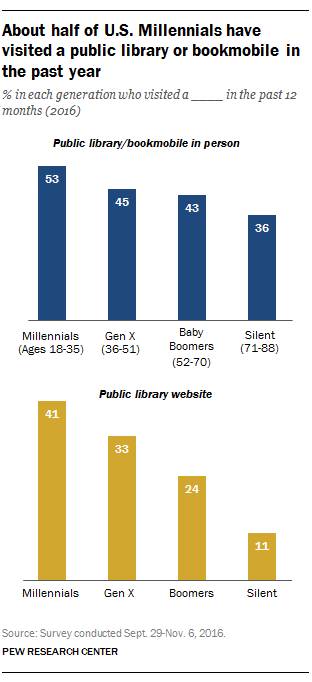
A new analysis of Pew Research Center survey data from fall 2016 finds that 53% of Millennials (those ages 18 to 35 at the time) say they used a library or bookmobile in the previous 12 months. That compares with 45% of Gen Xers, 43% of Baby Boomers and 36% of those in the Silent Generation. (It is worth noting that the question wording specifically focused on use of public libraries, not on-campus academic libraries.)

All told, 46% of adults ages 18 and older say they used a public library or bookmobile in the previous 12 months – a share that is broadly consistent with Pew Research Center findings in recent years.

Members of the youngest adult generation are also more likely than their elders to have used library websites. About four-in-ten Millennials (41%) used a library website in the past 12 months, compared with 24% of Boomers. In all, 31% of adults used a library website in the past 12 months, which is similar to the percentage that reported using library websites in late 2015.  READ MORE @

Tuesday, November 15, 2016

How to weather the Trump administration :: Head to the library

How to weather the Trump administration: Head to the library
LA Times: 11.10.2016 by David Kipen

Even now, in this riven country, after this whole entropically hideous year, most Americans still agree on at least one institution. Mercifully, it’s the one that may just save us: the public library.

Hear me out. In small towns and large, in red states and blue, libraries poll better across the political spectrum than any public trust this side of the fire department. In districts where millage increases don’t require a two-thirds vote (and frequently where they do, as in California) modest library bonds usually win.

If, as he claims, our new president really wants to invest in infrastructure, then America will need to build more than just roads and bridges. If Donald Trump is as smart as he insists he is, then he can prove it by strengthening our intellectual infrastructure. That means libraries — and he can start with one audacious symbolic act.

I’ve looked at libraries from at least four sides now, as a full-time book critic, a federal grantmaker (in a red administration!), a nonprofit lending librarian in an immigrant, working-class neighborhood, and on the faculty at UCLA. While midwifing the nonpartisan NEA’s one-city-one-book program, The Big Read, I visited more than 100 public libraries in 40-some states, with a fat deck of library cards in my desk now to prove it.

If all these experiences have taught me anything, it’s that librarians may be the only first responders holding the line between America and a raging national pandemic of absolutism. More desperately than ever, we need our libraries now, and all three of their traditional pillars: 1) education, 2) good reading and 3) the convivial refuge of a place apart. In other words, libraries may be the last coal we have left to blow on.

All the research out there — Census data, NEA reports, the Pew Research Center’s work on libraries and reading in low-income neighborhoods — all of it points toward reading enjoyment as the surest predictor of health, wealth and good citizenship. Readers volunteer more, vote more, even exercise more. And a recent Yale study categorically shows what most of us have long suspected: Readers live longer than nonreaders.  READ MORE @

Tuesday, October 25, 2016

Libraries 2016 - A portrait of those who have never been to libraries :: Pew

Libraries 2016
3. A portrait of those who have never been to libraries
Pew Research Center: 9.09.2016 by John B. Horrigan

Nearly half (48%) of Americans visited libraries in the past year. Roughly a third (32%) say they have used libraries at one time or another, though not in the past 12 months. Additionally, one-in-five (19%) say they have never visited a public library or a bookmobile. This has been a persistent trend in Pew Research Center surveys for five years, and we consistently see patterns in who these non-users are and how their views about libraries differ from more recent library users.

Those who have never been to a public library are more likely to be male (24% have never been to a library), ages 65 and older (26%), Hispanic (32%), black (28%), high school graduates or less (29%), or living in households earning less than $30,000 (27%). At the same time, the data show there are members of other demographic groups that have had no direct experience with libraries, including: 11% of those with college degrees and 12% of those in households earning $75,000 or more. Additionally, one-in-six parents of minor children (17%) say they have never been to a public library.  READ MORE @

3. A portrait of those who have never been to libraries

Tuesday, September 13, 2016

Libraries 2016 :: Pew Research Center

Libraries 2016 :: Pew Research Center
Trends in visiting public libraries have steadied, and many Americans have high expectations for what their local libraries should offer
Pew Research Center: 9.09.2016 by John B. Horrigan

Most Americans view public libraries as important parts of their communities, with a majority reporting that libraries have the resources they need and play at least some role in helping them decide what information they can trust. When asked to think about the things that libraries could do in the future, notable numbers of Americans respond in a way that can be boiled down to one phrase: “Yes, please.”

Public libraries, many Americans say, should offer programs to teach people digital skills (80% think libraries should definitely do this) and help patrons learn how to use new creative technologies like 3-D printers (50%). At the same time, 57% of Americans say libraries should definitely offer more comfortable places for reading, working and relaxing.

Yet, Americans are also divided on a fundamental question about how books should be treated at libraries: 24% support the idea of moving books and stacks in order to make way for more community- and tech-oriented spaces, while 31% say libraries should not move the books to create such spaces. About four-in-ten think libraries should maybe consider doing so.

A Pew Research Center telephone survey of 1,601 Americans ages 16 and older conducted from March 7 to April 4, 2016, finds that Americans continue to express largely positive views about the current state of their local public libraries. For instance, around three-quarters (77%) say that public libraries provide them with the resources they need. And 66% say the closing of their local public library would have a major impact on their community ­ although notably, just 33% say this would have a major impact on them personally or on their family.

There is also a growing sense that libraries can help people decide what information they can trust: 37% of Americans feel that public libraries contribute “a lot” in this regard, a 13-point increase from a survey conducted at a similar point in 2015.

A majority of Americans feel libraries are doing a good job of providing a safe place for people to hang out or spend time (69% feel libraries contribute “a lot” to their communities in this regard) as well as opening up educational opportunities for people of all ages (58%). And roughly half think their libraries contribute “a lot” to their communities in terms of helping spark creativity among young people (49%) and providing a trusted place for people to learn about new technologies (47%).

As in past Pew Research Center surveys of library use, the April 2016 survey also measured Americans’ usage of and engagement with libraries. Overall, 53% of Americans age 16 or older have had some interaction with a public library in the past year – either through an in-person visit, using a library website, or via a mobile app. Some 48% of adults specifically visited a library or bookmobile in the past 12 months, a modest uptick from the 44% who said that in late 2015. There was a four-point drop, though, in the number who visited library websites in the previous 12 months – falling from 31% who said they’d done so in 2015 to 27% in 2016.

There are a range of findings in the survey that might be surprising to those who are not deeply versed about events in and around libraries:

§   Young adults are more likely to have visited a library in the past 12 months than those ages 65 and older: 53% of those ages 18 to 29 visited a library or bookmobile in person in the past year, compared with 40% of those 65 and older.

§   19% of American adults say they have never visited a public library, including 11% of those who have college or graduate degrees. This report profiles those who say they have never in their lives been to public libraries.

§   The act of borrowing printed books is still by far the most popular activity at libraries, even compared with using computers: 64% of library users ages 16 and older checked out a book in the last 12 months, compared with 29% who used a computer at the library in the same time frame.

§   An emerging library “service” is its Wi-Fi connection, which can be used separately from the hours library buildings are open: 7% of those 16 and older say they have connected to a library’s Wi-Fi system when the library building itself was closed.

§   44% of those 16 and older say their public libraries loan out e-books, while 10% say this is not true of their communities’ libraries. Researchers at the University of Maryland report that 90% of libraries have e-book lending programs. So, many of Americans are not aware of this core service available at most local libraries.

§   The idea that libraries serve communities at times of crisis is now pretty well established. Some 55% of those ages 16 and older say libraries contribute a lot (19%) or somewhat (37%) when a natural disaster or major problem strikes the community. There have been dramatic examples of libraries becoming refuges and outposts, for instance after Hurricane Sandy in the Northeast in 2013.

§   The idea of “outreach librarian” is taking hold: 7% of those 16 and older have been visited in some way by a librarian in the past 12 months and another 4% have had that experience, but not in the past year.  READ MORE @

Thursday, June 9, 2016

Libraries & Learning :: Pew Research Center

Libraries and Learning

Majorities of Americans think local libraries serve the educational needs of their communities and families pretty well and library users often outpace others in learning activities. But many do not know about key education services libraries provide
Pew Research Center: 4.07.2016 by Lee Rainie

Most Americans believe libraries do a decent job of serving the education and learning needs of their communities and their own families. A new survey by Pew Research Center shows that 76% of adults say libraries serve the learning and educational needs of their communities either “very well” (37%) or “pretty well” (39%). Further, 71% say libraries serve their own personal needs and the needs of their families “very well” or “pretty well.”


As a rule, libraries’ performance in learning arenas gets better marks from women, blacks, Hispanics, those in lower-income households, and those ages 30 and older.

Library users think of themselves as lifelong learners

Additionally, these views arise in a context where strong majorities of adults consider themselves “lifelong learners” and libraries around the country are working to fit their programs and services into local educational ecosystems – both the formal parts of it (such as schools) and the informal parts of it (such as “do it yourself” learning opportunities). A recent Pew Research report found that 73% of adults say the label “lifelong learner” applies “very well” to them. 

Additionally, 74% of adults have participated in personal learning experiences of various kinds in the previous 12 months – we call them personal learners. And 63% of full- and part-time workers have taken courses or done training on the job to improve their skills in the past year – we called them professional learners.

Recent library users overwhelmingly embrace those ideas and activities. Fully 97% of those who used a library or bookmobile in the past 12 months say that the term “lifelong learner” applies “very well” or “pretty well” to them and a similar share of library website users (98%) also strongly identified with being lifelong learners.  READ MORE @


Tuesday, September 15, 2015

Libraries at the Crossroads :: Pew Research Center

Libraries at the Crossroads
The public is interested in new services and thinks libraries are important to communities
Pew Internet: 9.15.2015 by John B. Horrigan

American libraries are buffeted by cross currents. Citizens believe that libraries are important community institutions and profess interest in libraries offering a range of new program possibilities. Yet, even as the public expresses interest in additional library services, there are signs that the share of Americans visiting libraries has edged downward over the past three years, although it is too soon to know whether or not this is a trend.

A new survey from Pew Research Center brings this complex situation into stark relief. Many Americans say they want public libraries to:

◾ support local education;
◾ serve special constituents such as veterans, active-duty military personnel and immigrants;
◾ help local businesses, job seekers and those upgrading their work skills;
◾ embrace new technologies such as 3-D printers and provide services to help patrons learn about high-tech gadgetry.

Additionally, two-thirds of Americans (65%) ages 16 and older say that closing their local public library would have a major impact on their community. Low-income Americans, Hispanics and African Americans are more likely than others to say that a library closing would impact their lives and communities.  READ MORE !


Thursday, March 19, 2015

Pew Research Center :: Public Libraries and Hispanics

Public Libraries and Hispanics
Immigrant Hispanics Use Libraries Less, but Those Who Do Appreciate Them the Most
Pew Research Center: 3.17.2015 by Anna Brown and Mark Hugo Lopez

When it comes to public libraries, immigrant Hispanics pose both a challenge and an opportunity to the library community. On the one hand, this group, which makes up half of the adult U.S. Hispanic population, is less likely than other Americans to have ever visited a U.S. public library and is much less likely to say that they see it as “very easy” to do so. At the same time, Hispanic immigrants who have made their way to a public library stand out as the most appreciative of what libraries have to offer, from free books to research resources to the fact that libraries tend to offer a quiet, safe space. And they are more likely than other groups to say that closing their community library would have a major impact on their family. These are some of the findings of this latest installment of the Pew Research Center’s reporting on the Center’s landmark 2013 Library Services Survey.


Seven-in-ten (72%) Latinos ages 16 and older say they have visited a public library or bookmobile in person at one point or another in their lives, the survey shows, a share below that of whites (83%) and blacks (80%). But this finding masks a large difference among Latinos. Fully 83% of U.S.-born Latinos say they have visited a public library at some point in their lives—a share similar to that of whites and blacks. However, among immigrant Latinos, a smaller share—60%—say they have visited a public library or bookmobile in person.

Some public library services can also be accessed remotely through library websites. Here, too, though, the survey finds a gap in use between U.S.-born Latinos (49%), blacks (48%) and whites (45%) who say they have accessed a public library website and immigrant Latinos (27%) who say the same.

This gap in use between foreign-born Hispanics and U.S.-born Hispanics, whites and blacks may reflect foreign-born Hispanics’ views of the relative ease of using public libraries. According to the survey, just one-third of immigrant Hispanics say they would find it “very easy” to visit a public library in person if they wanted to do so. By comparison, 60% of U.S.-born Hispanics, 67% of whites and 59% of blacks say it would be very easy to visit a public library in person.  READ MORE !

Tuesday, July 8, 2014

Public libraries and the quiz-takers who love them - Pew Research Center

Public libraries and the quiz-takers who love them
Fact Tank-Pew Research Center: 7.08.2014 by Kathryn Zickuhr

The Pew Research Center recently released a library user quiz (“What kind of library user are you?”) based on the nationally representative telephone survey findings in our report, “From Distant Admirers to Library Lovers–and beyond: A typology of public library engagement in America.”

"Library Lovers" make up 10% of the population, according to a Pew Research Center survey.Much like our political typology, the library engagement typology sorts Americans ages 16 and older into different groups based on their habits and attitudes—in this case, based on how they use public libraries and perceive libraries’ importance in their communities. The quiz, which has been taken over 15,000 times, is a fun (and non-scientific) way for our website visitors and various community groups to compare their library habits to those of the general population.

So how did the online quiz-takers compare with the results of our nationally representative telephone survey?

One unsurprising finding: If you take a quiz called “What kind of library user are you?”, you probably know the answer.  READ MORE !

Monday, June 30, 2014

7 surprises about libraries in our surveys: Pew Research Center

7 surprises about libraries in our surveys
Fact Tank-Pew Research Center: 6.30.2014 by Lee Rainie

The Pew Research Center’s studies about libraries and where they fit in the lives of their communities and patrons have uncovered some surprising facts about what Americans think of libraries and the way they use them. As librarians around the world are gathered in Las Vegas for the American Library Association’s annual conference, here are findings that stand out from our research, our typology of public library engagement and the quiz we just released that people can take to see where they compare with our national survey findings: What kind of library user are you?

1 Each time we ask about library use, we find that those ages 65 and older are less likely to have visited a library in the past 12 months than those under that age. Equally as interesting is the fact that younger Americans (those ages 16-29) are just as likely to be library users as those who are older.

2 Although 10% of Americans have never used a library, they think libraries are good for their communities. We’ve identified this group of library users as “Distant Admirers,” and they are the majority of the nearly 15% of Americans ages 16 and older who have never been to a library.
 -40% of Distant Admirers report that someone else in their household is a library user.
 -2/3s of them or more say libraries are important because they promote literacy and reading
 -55% say the loss of the local library would be a blow to the community.

3 E-book reading is rising but just 4% of Americans are “e-book only” readers.

4 Those who read both e-books and printed books prefer reading in the different formats under different circumstances.

5 One of the big concerns in the publishing industry about selling e-books to libraries is that allowing free access to e-books through libraries might eat into book sales. In fact, Pew Research data show that those who use libraries are more likely than others to be book buyers and actually prefer to buy books, rather than borrow them.

6 One of the foundational principles of librarians is supporting the privacy of patrons. . . . . .many patrons are comfortable with the idea of getting recommendations from librarians based on their previous book-reading habits.

7 Many librarians are struggling to figure out how to think about their book collections in the digital age.  READ MORE !

Saturday, March 15, 2014

Pew Internet: Advocacy Tools for Librarians

What Do Americans Say about Public Libraries?


The Pew Research Center’s Internet & American Life Project has produced a series of reports presenting new research on library services, trends in reading habits and patron needs in the digital age. This three-year research program is funded by the Bill & Melinda Gates Foundation and informed by an advisory group, focus groups and surveys of library users, non-users, and librarians.

Thursday, March 13, 2014

Public Library Engagement in America - Pew Research

From Distant Admirers to Library Lovers–and beyond
A typology of public library engagement in America
Pew Research Internet Project: 3.13.2014 by Kathryn Zickuhr, Kristen Purcell and Lee Rainie

Among the broad themes and major findings in this report:

~ Public library users and proponents are not a niche group: 30% of Americans ages 16 and older are highly engaged with public libraries, and an additional 39% fall into medium engagement categories.

~ Americans’ library habits do not exist in a vacuum: Americans’ connection—or lack of connection—with public libraries is part of their broader information and social landscape. As a rule, people who have extensive economic, social, technological, and cultural resources are also more likely to use and value libraries as part of those networks. Many of those who are less engaged with public libraries tend to have lower levels of technology use, fewer ties to their neighbors, lower feelings of personal efficacy, and less engagement with other cultural activities.

~ Life stage and special circumstances are linked to increased library use and higher engagement with information: Deeper connections with public libraries are often associated with key life moments such as having a child, seeking a job, being a student, and going through a situation in which research and data can help inform a decision. Similarly, quieter times of life, such as retirement, or less momentous periods, such as when people’s jobs are stable, might prompt less frequent information searches and library visits.  READ MORE !

Thursday, December 12, 2013

How Americans Value Public Libraries in Their Communities - Pew Internet

How Americans Value Public Libraries in Their Communities
Pew Internet: 12.11.2013 by Kathryn Zickuhr, Lee Rainie, Kristen Purcell and Maeve Duggan

Americans strongly value the role of public libraries in their communities, both for providing access to materials and resources and for promoting literacy and improving the overall quality of life. Most Americans say they have only had positive experiences at public libraries, and value a range of library resources and services.

•95% of Americans ages 16 and older agree that the materials and resources available at public libraries play an important role in giving everyone a chance to succeed;

•95% say that public libraries are important because they promote literacy and a love of reading;

•94% say that having a public library improves the quality of life in a community;

•81% say that public libraries provide many services people would have a hard time finding elsewhere.

•Just 34% of Americans ages 16 and older of say that public libraries have not done a good job keeping up with new technologies, while 55% disagree.

•52% of Americans say that people do not need public libraries as much as they used to because they can find most information on their own, while 46% disagreed.  READ MORE !

This report is part of a larger research effort by the Pew Research Center’s Internet & American Life Project that is exploring the role libraries play in people’s lives and in their communities. The research is underwritten by the Bill & Melinda Gates Foundation.