Tuesday, June 24, 2008

Oregon Literacy, Inc. Closing After 40 Years of Service

Oregon Literacy, Inc. Closing After 40 Years of Service

The Portland-based nonprofit cites fundraising difficulties as the sole reason for closure of the literacy service organization.

PORTLAND – Citing financial problems resulting from fundraising difficulties, Oregon Literacy, Inc. has closed its doors, effective immediately. Oregon Literacy is a 40-year-old Oregon nonprofit with the mission of strengthening local and regional literacy programs, and supporting volunteer tutors that provide adult learners literacy services.

“It is with great respect for the history of the organization that the Board of Directors came to the decision to dissolve the nonprofit,” said Board of Directors president Jenni Newby. “Oregon Literacy has always been committed to promoting adult literacy in Oregon and it is unfortunate that the financial realities have resulted in the closure of this worthwhile organization,” Newby said.

The Board of Directors is working with partner organizations to ensure the continuation of important Oregon Literacy programs, like the ESOL Initiative, the LearnerWeb Project, the Literacy Line, and the Chalk it Up for Literacy event. Although the organization has closed, it is anticipated that programs previously supported by Oregon Literacy will find new homes with other literacy advocates.

Oregonians seeking literacy services can also contact local organizations directly; a service directory is available from the State of Oregon.

Friday, June 20, 2008

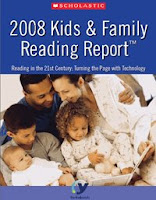
Kids & Family Reading Report: 2008


a national survey of 1002 individuals -- 501 children (5 to 17 years old) and one parent or primary guardian per child. Interviews took place through mall-intercepts in 25 major cities across the country from Jan - Feb, 08.

The survey was designed and analyzed by the staffs at Scholastic and Yankelovich. Quotas for gender and children’s age were established to ensure ample base sizes for analysis purposes.

Some key findings from the survey:

Kids:
89 % - say “My favorite books are the ones I picked out myself.”
68 % - say they love or like reading books for fun a lot
~ ~ 72 % of girls ~ ~ 63 % of boys
50 % - say there aren’t enough really good books for boys/girls their age


Technology and Reading:
~ Both boys and girls (age 9-17) say that they prefer to read books rather than read things on the Internet when they want to use their imagination
~ Boys are more likely to say the Internet is better than books when they want to read for fun ~ ~ Girls choose books
~ 2 of 3 children believe that within the next 10 years, most books which are read for fun will be read digitally – either on a computer or on another kind of electronic device


Parents’ Role:
82 % - say they wish kids would read books for fun more often
~ Parents who read books for fun daily are 6 times more likely than low frequency reading parents to have kids who also read for fun daily
~ Parents are a key source of book suggestions for their children, but nearly 50% all parents say they have a hard time finding information about books their child would enjoy reading, and especially parents of teens age 15-17


Other sites of interest:
The Screen Actors Guild Foundation wants to send a clear message: Our children and their education matter !

Family Literacy Centers assist families and individuals to effectively read, write and communicate in English with one-to-one tutoring assistance from trained volunteers, teachers, and parents.

National Council of Teachers of English
What Can Family Literacy Look Like ? What can we do at home ?

This list of suggested activities is short, and is designed only as a springboard for your own ideas. Begin with an activity you can do easily and comfortably with your children. Then add those activities that work especially well for you and your children.

+ NCTE's Parent's Guide to Literacy for the 21st Century

Read On @ Your Local Library: CalCat or WorldCat

Beyond Bedtime Stories: A Parent's Guide to Promoting Reading, Writing, and Other Literacy Skills from Birth to 5
by V. Susan Bennett-Armistead, Nell K. Duke, Annie M. Moses - Scholastic, 2007

Fast Start: Getting Ready to Read: A Research-Based, Send Home Literacy Program With 104 Reproducible Poems & Activities That Ensures Reading Success for Every Child
by Timothy Rasinski - Scholastic, October 2008

Reading Magic: Why Reading Aloud to Our Children Will Change Their Lives Forever
by Mem Fox - Harcourt, July 2008

Monday, June 9, 2008

English Spelling

English is too hard to read for children
Baffling spelling system is blamed as literacy falls short of level in other European nations
EducationGuardian: June 8, 2008 by Anushka Asthana (The Observer)


The English spelling system is 'absolutely, unspeakably awful'. That is the conclusion of new research that has found that children face 800 words by the age of 11 that hinder their reading because of the way they are spelt.

Monkey, asparagus, spinach, caterpillar, dwarf, banana, hankerchief, pliers, soldiers, stomach, petal and telescope have all been included on the long list of words that baffle children because they contain letter combinations that are more commonly pronounced in a different way.

The words have all been identified as problematic for reading, as opposed to writing, because of their 'phonic unreliability', according to the study The Most Costly English Spellings. It was presented yesterday at the conference of the Spelling Society, held at Coventry University. Masha Bell, the literacy researcher who carried out the work, argued that there were 200 words on the list that could be improved by simply dropping 'surplus letters' such as the 'i' in friend or the 'u' in shoulder.

Bell argued that the spelling system was a huge financial burden on schools and was to blame for poor literacy results compared with the rest of Europe. In Finland, where words are more likely to be pronounced as they look, children learn to read fluently within three months, she said. In the UK, academics have found that it takes three years for a child to acquire a basic level of competence. The tricky spellings make English particularly difficult for children with dyslexia and those from disadvantaged families, who are less likely to be read to regularly by their parents. READ MORE

100 of the most difficult words

Orange, foreign, rhinoceros, properly, vomit, tambourine, tournament, tourist, heaven, engine, exquisite, opposite, advertisement, gnarled, rigid, risen, sinister, spinach, video, vinegar, tie, wheelie, quiet, science, crier, pliers, soldier, Monday, mongrel, monkey, courage, magic, manage, palace, four, journey, gnash, gnaw, gnome, ghastly, guard, miracle, miserable, pigeon, pity, prison, month, mother, nothing, once, smother, son, sponge, tongue, wonder, almost, both, comb, ghost, gross, most, only, post, programme, deny, reply, July, obey, caterpillar, chapel, damage, dragon, fabulous, family, famished, garage, glacier, habit, hazard, hexagonal, imagine, panic, radish, miaow, powder, cauliflower, plant, pyjamas, raft, rather, salami, task, vast, kiosk, kiwi, machine, encourage, somersault, swollen, souvenir.

Understanding English Spelling
by Masha Bell – Pegasus, 2004

Wednesday, June 4, 2008

Father's Day and Literacy

Fathers Reading Every Day (FRED) is a program designed to encourage fathers, grandfathers, and other positive male role models to read to their children on a daily basis. The program aims to increase father involvement in children's literacy development and to improve the quality of father-child relationships. Developed by the Texas AgriLife Extension Service, an educational agency affiliated with the Texas A&M System.

Literacy Starts with the Family . . . And that Means Dads Too
by Willa C. Siegel, Barry Gary, and Jacqueline Davis

The impact of the connection between family literacy and fathers is powerful. Whether dads read bedtime stories, talk about the sports page, make a grocery list, write a child’s name, or explain the directions for a toy, they are presenting opportunities for their children to develop language and literacy skills. They are raising future writers and readers—and future writers and readers are future leaders (Darling 2004) . . . an excerpt from Head Start Bulletin

The Role of Fathers in Their Child's Literacy Development: Pre-K
Reading Rockets (2008)

Dads:
Did you know that reading with your preschool child can lead to better school performance later on? Studies show that when fathers participate in learning, children receive higher marks, enjoy school more, and are less likely to repeat a grade. Reading time creates a bond between you and your child that will stay with you both forever.

What if I don't like reading ?
~ Tell stories about when you were young
~ Recite nursery rhymes or jingles
~ Read environmental print: road signs or brand names on food containers
~ Ask your child about his day:
~ ~ conversation with adults helps children learn new words
~ Check out books of photography or art and talk about the pictures
~ When you are doing household projects, describe what you are doing
~ Involve your child in everyday writing tasks like shopping lists or paying bills
~ Create games that use letters, words, or problem solving
~ Use the language you are most comfortable speaking!
~ ~ Reading skills transfer between languages
~ ~and you will be better at playing with words in your native tongue

some sites to check out:

Parenting Tips for Dads - Because Dads Don't Always Think Like Moms
~ read aloud tips and books

Fathers Reading Everyday (from Dads Make a Difference Conference)
~ PowerPoint presentation
~ html version

10000 Fathers Reading
~
National Library Board of Singapore

Read On @ Your Local Library: CalCat or WorldCat
Every Friday
by Dan Yaccarino – Henry Holt, 2007

Daddy's Song
by Leslea Newman – Henry Holt, 2007

Perfect Day
by Remy Charlip – HarperCollins, 2007

When Daddy's Truck Picks Me Up
by Jana Novotny Hunter – Albert Whitman, 2006

Thursday, May 22, 2008

Value of Volunteer Time: 2007

Value of Volunteer TimeIndependent Sector is the leadership forum for charities, foundations, and corporate giving programs committed to advancing the common good in America and around the world.
2007 estimated dollar value of volunteer time: $19.51 per hour.

The estimate helps acknowledge the millions of individuals who

dedicate their time, talents, and energy to making a difference.
Charitable organizations can use this estimate to quantify the
enormous value volunteers provide.

Charts for:

1) Dollar Value of a Volunteer Hour: 1980 – 2007

2) Dollar Value of a Volunteer Hour, by State: 2006 *
~ Please note that 2006 is the latest year for which state-by-state numbers are available. There is a lag of almost one year in the government's release of state level data


Notes: The value of volunteer time is based on the average hourly earnings of all production and nonsupervisory workers on private nonfarm payrolls (as determined by the Bureau of Labor Statistics). Independent Sector takes this figure and increases it by 12 percent to estimate for fringe benefits.


Other Reports of Interest

Volunteering in America: 2007 City Trends and Rankings (photo)by Corporation for National and Communtiy Service

~ uses volunteer data collected by the U.S. Census Bureau and Bureau of Labor Statistics from 2004-2006. It ranks and includes profiles for 50 of the largest cities including: volunteer rate, types of organizations, main volunteering activities, average hours per year, rates for age and gender and key trends and highlights. Some of their other reports:

~ Still Serving: Measuring the Eight-Year Impact of AmeriCorps on Alumni
~ AmeriCorps: Changing Lives, Changing America
~ The Health Benefits of Volunteering: A Review of Recent Research


Volunteering in the United States, 2007Bureau of Labor Statistics
About 60.8 million people volunteered through or for an organization at least once between September 2006 and September 2007. The proportion of the population who volunteered was 26.2 %. This 0.5 % decrease in the volunteer rate follows a decline of 2.1 % points in the prior year. The volunteer rate had held constant at 28.8 % from 2003 thru 2005, after rising slightly from its 2002 level of 27.4 %.

Visit America's Literacy Directory to volunteer in literacy programs in your area.

Join Friends of Libraries USA and support your local library.

Find a volunteer opportunity in your community or nationwide @ Volunteer Match.

Monday, May 19, 2008

VALUE: Adult Learner Involvement Survey

Voice of Adult Learners United to Educate

VALUE is updating its research on adult learner involvement throughout the U.S.

If you would like to share information about adult learner involvement in your state or in your local program, please complete the 10-question survey. Some sample questions.

~ state conferences that include students as participants or planners
~ if you have a student group, how is it structured
~ what areas of leadership have students made achievements
~ is there funding for involvement outside the classroom
~ what positions do students hold in programs


The results of this research will be posted in the "In the States" section of the VALUE web site.

Friday, May 9, 2008

National Library Legislative Day: May 13-14

May 13 and 14

Support your local library. Librarians and library supporters will rally in Washington D. C. to advocate for libraries. Urge your representatives to support libraries.

Can’t travel to Washington, DC ?

You can still participate in National Library Legislative Day by organizing Virtual Library support @ FOLUSA in your state by phone, fax, and email from May 12 and 16.

F Y I
3 to 1: U.S public library cardholders vs Amazon customers worldwide

8 million questions a week answered by Reference Librarians
~ the line of people would stretch from New York City to Anchorage, Alaska

$ 31.00: Annual expenditure by Americans for public libraries
~ about the cost of 1 hardcover book

Return On Investment (ROI)
~ Florida’s public libraries return $6.54 for every $1.00 invested

~ Estimate your ROI for every $1.00 in taxes you invest in your library

CLICK for more:
~ ROI
~ Economic Benefits of Libraries
~ Library Facts for Legislators

American Library Association